Mostrando entradas con la etiqueta Literatura. Mostrar todas las entradas

lunes, 3 de septiembre de 2012

Reciclaje

Tal vez el ejemplo más conocido de la serie sea el de las Meninas con que Picasso homenajeó a Velázquez. Y seguramente el último de la serie, el Ecce Homo de doña Cecilia, será el más cuestionado. La verdad es que el arte exige una pausa de muchos años para la correcta crítica, y mientras tanto el proceso de "mashup", homenaje, reciclado o vulgar copia -en todos los aspectos del conocimiento- sigue su curso.

El arte incorpora la mirada de los otros. "Beauty is in the eyes of the beholder", decía un tal Shakespeare, y tal vez ésa sea la diferencia con otras disciplinas donde sólo el juicio de los pares puede deparar una justa divisoria de aguas. En todos los órdenes de la vida hay que educar el ojo para poder pronunciarse, y estoy convencido de que existen en cada campos expertos, pelmazos, y gente del monton que podrá justificar su opinión en mayor o menor medida.

Y creo que ese es el punto, exhibir los criterios. Botero jamás me gustó, pero siempre deberé aclarar que no soy un experto. Y a lo sumo confesaré además que en materia pictórica estoy detenido en Turner.

miércoles, 19 de septiembre de 2007

Copyright and Copywrong


Fist Monday is one of my favourite online journals. One of the kind you still bookmark to browse from time to time, neglecting RSS or feeds customizations.

In the issue of September there are some expressions of Siva Vaidhyanathan about what he calls: “The Googlization of Everything", related to the Google move on scanning everything and the impact on copyright concerns and the future of books -looks rather orwellian, or at least bradburian (:D).

  • Google wants courts to rule that their project of scanning in millions of copyrighted books and then placing them on their search service in highly cut up form, in other words offering merely snippets of the entire book should qualify as a fair use of the copyrighted work.
  • Google wants courts to make a general rule about fair use and accept that the initial scanning of millions of copyrighted books should be irrelevant to the concerns of the court, and that the copyright issue should be based entirely on the user experience.
  • ...what I’m afraid of is that Google will certainly lose in court, and what will happen is courts will generate an indelicate view of fair use, a highly restricted view of fair use and will ultimately reign in a lot of future experiments (...) then every other player is going to be coward away from doing this.
  • Google is not required to make sure that the scanning process actually gets every page of every book and makes it all clear. There are no requirements that Google use metadata effectively or the metadata certainly already attached to books. There’s no guarantee that Google will offer people the best possible results for their queries. And most importantly, Google does not do anything to protect user confidentiality and in the world of book searching this is a really important factor. It is an essential part of librarianship. It is an essential part of the ethics and policies of libraries.
  • It’s nice to believe that a company like Google which has the best possible programmers and some of the smartest people in the world working for it is on top of this. But I think we need more than faith. I think this is too important a project to put into a black box.
To some extent, Mr. Vaidhyanathan scores some points here -and maybe does a little bit of Google paranoia-. The issue here is, no matter if Google wins or not: the point is that little can be said about copyright in the future if the "fair use" mood is allowed in courts. Thus all our ideas about property are changing in a very fast way.

In other words, should I register from now on any of my pretentious posts here? I'd rather not do it.

Resumen en Español:
  • Si Google fotocopia cada libro estamos en peligro porque sienta un precedente en materia de copyright y hay problemas de confidencialidad de quienes acceden a la info.
  • Si Google pierde en los jurados ningúna biblioteca o Google-like intentará hacer lo mismo en el futuro.

martes, 15 de mayo de 2007

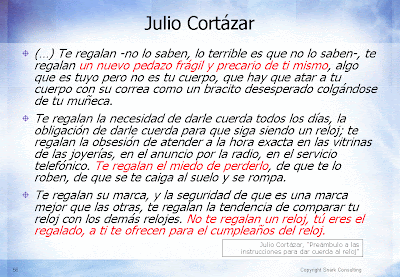
Cortazar ya lo sabía

Alfons Cornella y su sabiduría respecto del tiempo.

Infoxicación. Continua atención dispersa.
Síndrome del Alt-Tab o Working-interruptus.
Como sea.
Treinta años antes, Cortazar ya lo sabía:


martes, 1 de mayo de 2007

Slow Marketing, el Tiempo y Cortázar

Cuando se habla ahora de Slow Marketing, la imagen del reloj astronómico de Praga viene a mi mente. El tic-toc del correr de las agujas nos marca el escaso tiempo, y la figura del esqueleto danza al compás de las campanadas, y tal vez de algún fracaso.

El Marketing es de por sí ambicioso en cuanto a resultados inmediatos: cómo se conjuga esto con la noción de finitud de la imagen, o con las "Instrucciones" de Cortázar, de más arriba?

Como tantas otras veces, creo que ya todo estaba antes en la Literatura. Queda para mí no sólo el Slow Marketing, sino el Slow Reading que me impedirá leer a todos los clásicos.

Somos cada vez más espectadores. Aún leyendo los clásicos, acuñando conceptos o formando nuestra videoteca. La gente acumula mp3 como si en ello le fuera la vida. Los negocios exigen otra cosa.

viernes, 27 de abril de 2007

Herzog

"For instance? Well, for instance, what it means to be a man. In a city. In a century. In transition. In a mass. Transformed by science. Under organized power. Subject to tremendous controls. In a condition caused by mechanization. After the late failure of radical hopes. In a society that was no community and devalued the person. Owing to the multiplied power of numbers which made the self negligible. Which spent military billions against foreign enemies but would not pay for order at home. Which permitted savagery and barbarism in its own great cities. At the same time, the pressure of human millions who have discovered what concerted efforts and thoughts can do … "


"Herzog", Saul Bellow (1964)


sábado, 14 de abril de 2007

Sensaciones inaugurales en Snark Consulting


Por qué Snark Consulting?

Snark es una contracción entre shark (tiburón) y snake (serpiente).
La imagen que evoca es la de algo demasiado amenazante como para un servicio de consultoría.
Y sin embargo, lo literario le gana a todo.

"The Hunting of the Snark" es uno de los libros menos conocidos de Lewis Carroll, y sin embargo uno de los mejores. No fue traducido, tampoco, a muchos idiomas. Los dibujos son de Holliday en la versión original. Su sentido, hasta ahora se discute: un monstruo en algún lugar, que una tripulación de sujetos border está dispuesto a cazar en un barco construído al revés. Un sentido, una alegoría? Carroll nunca respondió.

Snark Consulting es consultoría pequeña, concreta, y efectiva para clientes telcos, móviles y de IT. No creo en "Boojums" -gastar millones de dólares en branding-, no requiero un ejército de tipeadores de Power Point cuando -con el conocimiento previo de 15 años en distintas empresas, y con las herramientas de Web 2.0- poca gente eficiente y bien dirigida puede prestar un excelente servicio.

Ya seguiremos en contacto.