miércoles, 30 de enero de 2008

Mozilla - Ten years after
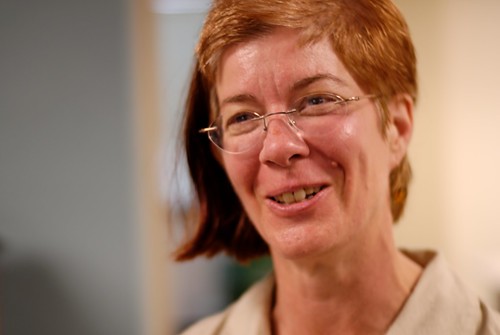


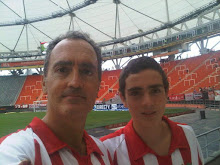
Spanish highlights: el sujeto del extraño peinado es Mitchell Baker, el CEO de Mozilla. Estos dias se festejan los 10 años del browser (originado en Netscape, para los nostálgicos). No todo es fiesta: seguramente estará en las noticias el porqué de la pulseada Mozilla vs Explorer.

Esto no es más que otro capítulo de la vieja lucha establishemnt empresa-céntrica vs la libre iniciativa. Al final del día, mis amigos que saben dicen que Mozilla es muchísimo mejor. El futuro, según cuentan las propias autoridades de Mozilla, es Firefox 3: "moverse" en la información

=========================================================

Those were the days, my friends... when Netscape was released. January 1998. Ten years ago Internet was still rising, only a hundred or so of millions in the whole world, dotcom collapse didn´t occur yet, plenty of investment in Silicon Valley and here in LatAm watching how portals and ISP were adquired by major telcos.

But something is still going on. The "way we see the web" (WWSTW, and I´d like to be given the credits of this in other ten years) is still an issue. Is there any analogy in other fields? Explorer works "fine" in most applications but Mozilla excels. Explorer fails in more socialized versions of the web (try new Facebook apps in Explorer). But as perversity is the name of the game, most of designers thinks most in Explorer while doing their job.

Flashback, ten years ago. How was the feeling, then?

MOUNTAIN VIEW, Calif. (January 22, 1998) -- Netscape Communications Corporation (NASDAQ: NSCP) today announced bold plans to make the source code for the next generation of its highly popular Netscape Communicator client software available for free licensing on the Internet. The company plans to post the source code beginning with the first Netscape Communicator 5.0 developer release, expected by the end of the first quarter of 1998. This aggressive move will enable Netscape to harness the creative power of thousands of programmers on the Internet by incorporating their best enhancements into future versions of Netscape's software. This strategy is designed to accelerate development and free distribution by Netscape of future high-quality versions of Netscape Communicator to business customers and individuals, further seeding the market for Netscape's enterprise solutions and Netcenter business.
========================================================

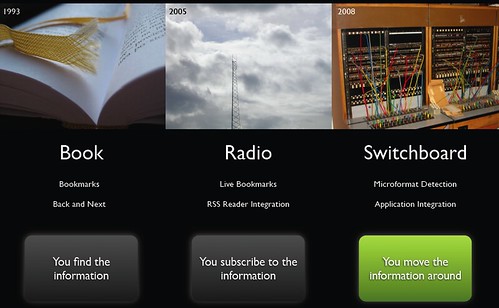
What about the future? Perhaps this slide talks by himself. According to Mozilla developer Alex Faaborg the idea is to move around the information -far beyond bookmarking or even RSS feeds-. According to Alex, microformats are the answer to this issue - but which ones will Firefox natively support? Alex outlined 3 fundamental types: identity (hCard), geo (geo, adr), and calendar (hCalendar).

martes, 22 de enero de 2008

Facebook in a nutshell -or two-


If you are familiar to this blog you`ve realized by now that I don´t like Facebook very much.
I have two reasons for that:
  • There is always a continuous crossing of boundaries (personal vs professional).
  • You always have to check on new indiscrete applications -or just avoid them-. If not carefully understood their impact, this applications may invade your "friends" space.
Having said this, here´s a list of Facebook characteristics that may be of some help, or as I put it, "Facebook in a nutshell".
  1. The Wall is merely a space. It is placed on each user's page allowing friends to post messages for the user to see. One user's wall is visible to anyone with the ability to see their full profile. Many users use their friend's walls for leaving short, temporal notes.
  2. One of the most popular applications on Facebook is the Photos application, where users can upload albums of photos, tag friends, and comment on photos. About 60 million photos are added each week. That means 5 terabytes of disk space.
  3. A somewhat naive feature in Facebook are gifts. They are displayed in the website's gift shop. Frinds can send "gifts" –which are small icons of novelty items- to each other by selecting one from Facebook's virtual gift shop and adding a message. Gifts given to a user appear on the recipient's wall with the giver's message, unless the giver decided to give the gift privately, in which case the giver's name and message is not displayed to other users. Facebook users are given one free gift to give upon account signup.
  4. Facebook includes a "poke" feature which allows one user to send a “nudge" (in the Messenger sense) to another. According to FAQ "a poke is a way to interact with your friends on Facebook" (...) "People interpret the poke in many different ways, and we encourage you to come up with your own meanings." In principle this is intended to attract the attention of the other user. Some users take it as a sexual advance. This interpretation of the feature inspired a popular Facebook group titled "Enough with the Poking, Lets Just Have Sex", which, as of December 2007, has more than 340,000 members.
  5. The "status" feature allows users to inform their friends and the Facebook community of their current whereabouts and actions. This very much resembles Twitter functionalities.
  6. Facebook events are a way for members to let friends know about upcoming events in their community and to organize social gatherings. Events can be open, closed, or secret. When setting up an event the user can choose to allow friends to upload photos, video, and posted items.
  7. The Facebook Platform provides a framework for developers to create applications that interact with core Facebook features. Now there are more than 10,000 applications. Some metrics have changed along the months, as Facebook changed the way in which the popularity of applications is measured, in order to give more attention to the more engaging applications. There is some criticism about the attention some applications received only by growth; in fact they were highly viral, yet useless applications. This effect deserved the name of "cornucopia of uselessness." OK, my judgement is biased...
  8. Facebook released an application of its own for sharing videos. Users can add their videos with the service by uploading video, adding video through Facebook Mobile, and using a webcam recording feature.

Since I have some passion for contradiction, I have recently joined the Keira Knightley Atonement Green Dress Appreciation Society Facebook group. Useless? Well... it´s another Facebook application, you see.

martes, 15 de enero de 2008

MacBook Air vs Sony Vaio

The VAIO, as an ultraportable machine with long battery life, is impressive. The integrated DVD drive is a plus, too. A Sony Vaio IS TINY by definition (not designed for huge fingers).

The MacBook Air, on the other hand, will be an impressively portable, basically-full-size computer. It won’t feel small and tiny like the VAIO but it likely won’t weigh you down much (about 1.5 kg) either. Both laptops have similar perfomances based on Corel 2 Duo processors with some advantage for MacBook. Same happens with RAM: Apple’s comes with 2GB of 667MHz DDR2 SDRAM. Sony’s comes with 1GB of 533MHz DDR2 SDRAM.

Finally, Sony’s site has the VAIO listed at $2099. You can currently get it at Best Buy for $1849. The MacBook Air is $1799, launch price.

miércoles, 9 de enero de 2008

Jennifer Lopez charts

"A Jennifer Lopez chart is an informal technical analysis term used to indicate the rounding bottom in a stock's price, especially as seen on a chart or graph. The term is inspired by singer and actress celebrity Jennifer Lopez, who is known for having a curvaceous figure".

No fun at all. Quote belongs to Investor Words. I wonder about some Angeline Jolie index.

martes, 8 de enero de 2008

Facebook: Are you a Zoosker?

So the big-big benefit of Facebook is letting developers push their content into Facebook home with zero effort. Good try. And what about the users? Do they know what are they using?

In real life you don´t try new medicine unlees it is advised -your doctor, a friend, whatever-. In Web 2.0 you´re just at one click away of installing unknown apps in your Facebook profile. Throwing snowballs (is it as stupid as I reckon?), promote hotness (whatever it is), bother all your LinkedIn connections trying them to get Facebook-ed, or just buy installing Zoosker -proposing yourself for "socializing" in its purest form.

In a recent Yahoo! post a married woman asked simply "What would you do if you find your husband added the 'zoosk'application on Facebook? Most of the answers were "talk to him, he probably didn´t meant to do it". That´s the problem with easy integration of features, not to mention the long-discussed surrender of personal information. "Zoosk is a fun way to socialize and meet other singles in your area" says Facebook. Once you click it, it´s not only that you sex appetite seems to be reloaded; everyone is informed in black and white that you are -so to speak- craving for casual sex.

One final comments from a user. "I haven't got 15 single friends to invite to this stupid app, and I shouldn't have to bug the ones that have no need for it just so I can use it!". As I see it, I have only two issues about this apps
i) the instant spread of the app to all contact list -maybe you didn´t want to-
ii) the blur between personal and professional activities.

As we have seen many times, the second issue is a key factor in Web 2.0 developments.

jueves, 27 de diciembre de 2007

Naked Truth 2.0

La mayor parte del tiempo la gente de las empresas rodea un cierto hecho, ofrece versiones complementarias... pero no siempre cierra filas sobre una verdad descarnada, una "naked truth" que sea punto de partida. Como se comentaba antes, cuanto más amplia es la comunicación, más acartonada y más distante de la realidad se torna. De paso, soy de los que cree que existe una realidad sobre la que es posible coincidir.

En función de la madurez que uno tenga, esta distancia puede lastimar. "Ser bicho" es saber manejar estos códigos, para ciertas personas. Para otros, "ser bicho" es mentir, o al menos manejar aviesamente la información. Sospecho que la clave del entendimiento pasa por analizar cuál es el nivel de verdad que está dispuesta a admitir una organización.

Esto, leído "en módulo", puede resultar trivial. Pero es la causa que explica porqué hay gente que no puede trabajar en empresas grandes; el manejar distintos matices o el aceptar ambigüedades simplemente les resulta inaceptable -y hay algo autorreferencial en esto-. Me pregunto cómo se edificará el concepto de verdad en un contexto Enterprise 2.0. El ejemplo sencillo es el blog de la empresa, donde hay (debería haber) algo más de espontaneidad, capacidad de construcción de una verdad en común, capacidad de tolerar comentarios adversos. Imagino un post sobre resultados de ventas menores a lo esperado, link a planillas que expliquen causas (menor stock, menor impacto de la publicidad, etc) y la aparición de verdades contradictorias moderados por un experto en comunicación que... deberá saber construir (definitivamente, él sí) sobre la ambigüedad).

Web 2.0 is a warm gun, baby.

viernes, 14 de diciembre de 2007

Some questions for 2008

We just can´t foresee what will our society look like in coming years. Neither can we assess the real impact of undergoing changes in technology and communication. Probably 2007 will be remembered as the year of x,y,z events we cannot even recognize these days. The year China slow down? The Euro year? The first year weather issues were taken more seriously? Who knows.

All in all we, we do like challenges. As Snark Consulting deals with changes in Marketing and Technology in a Telco and web 2.0 ecosystem (check our last report on the matter), we dare to make our best wishes for the year to come, but with not solemnity at all.

The business in Snark Consulting is to be curious about next changes. The toast we propose here is not made of alcohol but of questions. Do the honours with me, rise your glasses, and ask yourself with curiosity:

  • Do we have enough of walled garden ideas (this web 2.0 gadget with this telco or that exclusive mobile phone)?
  • Is it Google going mobile when their own phones?
  • Are common individuals -mass stream- finally getting familiar with communication breakdown -yes I do like Led Zeppelin, but I´d like to go beyond the song-. Or just new teenagers will handle going indie twittering the whole life?
  • Is web 2.0 going corporate as it seems, or it is just another way of controlling employees ideas and underlying currents within organisation?
  • Is web 2.0 being profitable in 2008, or the last adquistions are a minor bubble -I think not.
  • Are you going to do the usual Christmas spam -I hope not!

No more words. Let´s be prepared for the unexpected, and make your wishes.

martes, 4 de diciembre de 2007

Facebook: a diminishing giant

  • Moto: "Facebook is a social utility that connects people with friends and others who work, study and live around them. "
  • Suspect: as something gets bigger and bigger, it losses some of the essential meaning.
  • Fact: Facebook's Beacon was released inNovember as a part of its Facebook Ads platform. It is designed to track the activities of Facebook users on a series of 44 Web sites, and to report those activities back to the users' Facebook friends, unless specifically told not to do so. The lack of disclosure about what was going on has led to a maelstrom of criticism against Facebook over the past few days. Facebook's tracking was far more invasive and extensive that the company originally let on.
  • In the media: "We believe that in this market people will constantly try to find ways to exploit the personal information they have and that they gather" (Mark Cooper, CFA).
  • My two cents on this: I ask myself how web2.0 giants can grow and be profitable without forgetting its roots and letting down their users?
  • Addendum: Facebook users are winning the battle.

domingo, 25 de noviembre de 2007

Conferencias

Martes 13 de noviembre, final de la primera jornada del evento de Convergencia sobre IP, en el Sheraton. Los cuatro panelistas miran al chairman como si fuera esto un partido de tennis. Y no lo es, pero dar conferencias es un deporte que también tiene sus reglas, que me gustaría revisar:

  • Antes de la charla: pensar cuál es la audiencia. En este caso había un gap grande entre un auditorio del mundo de los "fierros" y los temas que ofrecieron los panelistas. No se puede explicar todo, asì que conviene sólo elegir pocos ejemplos bien claros.
  • Tomarse la molestia de llegar una hora antes, y de chequear que funcione todo bien.
  • Conocer al chairman y a los otros panelistas. Puede haber superposición de temas.
  • Sondear el ánimo del público. En el caso de este evento, era tiempo de descuento... no había lugar para grandes soliloquios.
  • Jamás debe uno excederse del tiempo permitido. Se puede contar la historia de Web 2.0 en un minuto, o hablar sobre los arrecifes de la Gran Barrera Australiana durante años.
  • No hablar demasiado, ni demasiado rápido. Más imágenes que texto. Jamás repetir lo que está escrito (leer, se entiende?).
  • Si hay preguntas con cierta tendencia en contra, jamás pelearse con el público. Explicar el punto de vista propio con elegancia y conceder la posibilidad de razón en el otro.
  • No gesticular. Los micrófonos, que pueden rechinar a cada movimiento, no tienen la culpa de nuestros nervios. Los vasos de agua que pueden volcarse, tampoco.
  • Si no se posee gran histrionismo, no hacer chistes. Se puede involucrar al público con preguntas muy directas, pero la barrera del humor es difícil de cruzar. Martín -el del medio del panel- lo hizo bastante bien.
  • Apagar el celular. Directamente. Qué puede pasar en esos 15 minutos? No hacerlo puede distraer y provocar fastidio en el público.
  • Peter Curwen, un amigo de Inglaterra, solía decirme: "por qué tener miedo? Trabajaste mucho para llegar a dar esta charla. Es un honor". El ni siquiera pasaba por la humillación del PowerPoint, era un narrador nato y a lo sumo repartía apuntes entre el público. Claro, Peter era muy bueno.
  • Finalmente si algo sale mal... uno está allí haciendo un esfuerzo, creo que no hay culpas. Hay que apurar el trago, cruzar los dedos y esperar que se reinicie el laptop, o que el sonido funcione. No olvidarse de pedir ayuda, si es necesario.
Mi tema fue Web 2.0 corporativa. En breve la subiré al SlideShow.

domingo, 28 de octubre de 2007

Enterprise 2.0


Enterprise 2.0 is more than building a blog within a company.
It is more -by far- than a new communication channel for customers or employees.
It is so important that I would -almost- avoid flasy diagrams like the one above.
No time for examining new memes in the trend.

Enterprise 2.0 applications are becoming more than just wikis, blogs, tagging tools, and ajax front-ends. Imagine new networking capabilites in the company, evolving clusters of knowledge, or subtle boundaries you´d never imagined before. It is about designing wisely who has the control of the information, and what to do with it according to your human resources.

So, some questions might arise. Do you know there is risk? Who is sharing the knowlege? Are they asking for reward? Where are the information bottlenecks? If information would flow almost free, no matter IT geeks would do... would you feel comfortable with this fact?

This is not Web 2.0. It has to do with lower number of users, non-flat hierarchies, nothing to do with "showing your real self" or making fun. And I´m sorry about that.

So please, if you read somewhere about someone asking for an Enterprise 2.0 ROI, it´s a complete nonsense.

lunes, 22 de octubre de 2007

Telefokia

El anuncio de hace pocos dìas de Nokia y Telefonica parece cambiar las reglas del juego. "Nokia will customize the new Multimedia Menu to provide easy access to Telefónica services... Similarly, Telefonica customers will be able to access all Nokia services through the Multimedia Menu".

Consecuencias?

  • Parece en sintonía con la iniciativa Ovi según la cual Nokia pasa a ser Nokia 2.0 -lo sé, no me gusta el término-. En fin: que los fineses no son gadgets, sino que son servicios para comunicar gente.
  • Telefónica advierte y da prioridad a todo el movimiento social de la web, y reconoce que esto pasa al mundo móvil. A la vez delega en alguien que sabe manejar interfases y desarrollar con rapidez.
  • Para el cliente esto es bueno. Nokia será un medio único de contacto y no cien maneras distintas de hacer las cosas para cada aplicación distinta.
  • Si Facebook permite todos los widgets imperantes, qué pasará cuando Nokia tome el control de un celular de Telefónica? Imagino un escenario de "sòlo apriete este botón y verá sus contactos en la pantalla" con un suave disclaimer en segundo o tercer plano bloqueando la caja de Pandora legal que niegue responsabilidades de Nokia y Telefónica.
  • Imagino que todo esto aplicará a terminales S60 para arriba. Si esto es así, y el bottom line es "manda Symbian", este acuerdo puede abrirse a otros vendors móbiles.
We´ll see...

sábado, 13 de octubre de 2007

Infoxication

Infoxication, or more plainly, the intellectual intoxication, is produced by an excess of information. This excess is due to the availability of information in different formats. This availability produces occasionally some difficulties in assimilating such a volume in a reduced time.


The consequence is time becoming a very scarce resource and, therefore, getting the attention of the audience becomes a priority in Internet. Or in ordinary life.

A second related idea is this: the product between information and attention is a constant for each individual. In other words, as you become more teachie, it´s very likely your communication skills would go down.

domingo, 7 de octubre de 2007

Charla en la UCA


El sábado pasado, gracias a la invitación de Juan Carlos Lucas, tuve la oportunidad de intercambiar algunos comentarios sobre tendencias en Telcos, Móviles y Web2.0 con su grupo del posgrado en la Universidad Católica Argentina. Como se ve más arriba, queda un resumen en SlideShare con los conceptos más importantes.

No puedo hablar de jet-lag, pero siento que llegué algo quemado y sobre la hora. No hubo tiempo para lirismos: traté de ser bien especíco en las desventajas respecto del primer mundo, en cómo tenemos el radar seteado para buscar oportunidades, y qué espacio hay para emprendedores en un ámbito de grandes players, que sin embargo pasan por alto algunas cuestiones capitales.

Va entonces mi sincero agradecimiento a Juan Carlos por la invitación, y a los alumnos por su buena disposición, curiosidad y buena onda. Caminando de vuelta en ese mediodía por los diques, pensaba que Puerto Madero era una buena metáfora de la charla: si hay conocimiento y capital humano, uno se siente como en el Primer Mundo.

lunes, 1 de octubre de 2007

Twitter político


Atención: Sobisch y Asís siguen a la comunidad argenta de Twitter.
Fondo rojo.
La leyenda es amenazante, agresiva: "Hola...".

Una nueva utilidad? La confirmación de que Twitter no va?

miércoles, 26 de septiembre de 2007

Mobile Television: Conclusiones (4 de 4)

La próxima gran cosa es la televisión por móvil. En las últimas dos décadas la industria deambuló entre indefiniciones menores: si el cliente estaba fijo o móvil, si el standard era ése u otro, si el contenido era el rey o no. Ahora todas las piezas encajan; sólo falta gente con sentido común para hacer bien los negocios. Las fuentes indican que en 2010 50 millones de personas estarán viendo contenidos televisivos adaptados para el móvil. End of File.

Mientras en Argentina los grandes popes intuyen que con la soja empieza y acaba el mundo, y las normas sobre TV en el móvil siguen sin definirse, el mundo parece ir hacia DVB-H -simplemente porque hay demasiados vendors apuntando en esa dirección- con algún experimento interesante en DAB o algún espasmo de Qualcomm en Estados Unidos. Puede haber muchas pruebas en redes 3G pero ante la menor inquietud de que el video congestione la voz... los operadores correrán hacia una diferenciación tecnológica. Y hacen bien.

La regulación llegará tarde; aquí y especialmente en Europa. Pero qué le importará al cliente? Aquí volvemos al rationale de las cavernas: le importará la calidad del servicio. Ver bien por los pocos minutos que su atención pueda dispensarle. Y los productores de contenido no estarán felices al ver que el negocio se demora, cuando todo lo que ellos tienen que hacer es una ligera adaptación.

Así que estamos entre Escila y Caribdis, como en el viaje de Ulises. Escila significa que todo este viaje tecnológico termine con un servicio en 3G/4G gratis, fidelizador, para pocos. Caribdis significa regulación, otra banda, un servicio premium, gente dispuesta a pagar al menos 10 USD y la felicidad de los proveedores de contenido. Veremos qué ocurre.