Mostrando entradas con la etiqueta Buscadores. Mostrar todas las entradas

lunes, 10 de agosto de 2009

El Señor Información

(A pedido del público, retomo la sección Dialoguitos en la Webosfera).

Contexto: International Telecommunications Society Conference del 2001. Todos vinieron a Buenos Aires, todos, en los últimos estertores del dolar barato. Entre ellos quien creo que es el Señor Información, Hal Varian. Es ahora un top ten en Google y pueden creerme, es un grosso. O más bien pueden buscar chequear su impresionante trayectoria. Esta conversación ocurrió en el Sheraton en inglés, duró un minuto y sin embargo me hizo pensar mucho a lo largo de los años.

- Dr. Varian, tiene un minuto?
- Hem, no, pero bueno.
(Ocurre un fugaz intercambio de tarjetas. Me pregunto por qué a ciertos intelectuales les gusta vestir de marrón. Él mira a través mío, como si mi color fuera transparente. Solo ve un joven subproducto de la fauna local, sin valor. Tal vez no esté errado.)
- Tengo la propuesta para hacer un Master en Syracuse.
- En qué?
- IRM. Information resources management.
- Ah, muy bien. Syracuse está muy bien...
- Pero me parece algo teórico. Fíjese que estamos aquí en esta conferencia hablando de cuestiones muy diversas, pero en realidad lo que las Telcos quieren es profit. Y esto de la información... a mí me gusta pero no me creen mucho que tenga que ver.
-Information means profit.
- Sí, eso yo lo sé y Ud también, pero...
- Es el futuro. (se exaspera) Piense... Si las Telcos, o si cualquier empresa, no sabe gestionar la información, está perdida.
- Tiene razón... dígame, Syracuse es la mejor?
- No. Berkely. La mejor es Berkeley.
- Por que?
- Porque yo dirijo Berkeley!

Apenas me saludó con un gesto. Lo vi irse, alto y encorvado. Fast forward: la apuesta era grande, la beca no cubría todo, no me daba para llevarme a mi familia ni para hacer el master a distancia, vino Google, yo me fui de la Telco, Varian fue a Google, y hace un par de días afirmó que la profesión del futuro es la estadística (artículo imperdible del NYT).

Me? I´m just a lawn mower. You can tell me by the way I walk.

lunes, 8 de junio de 2009

Poderoso caballero es Don Dinero

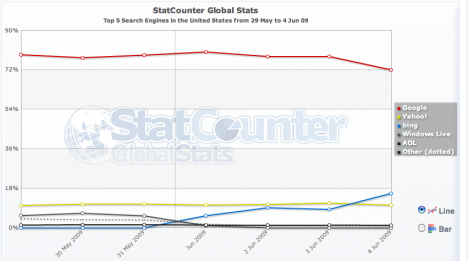
Los expertos coinciden en que Bing, el buscador de Microsoft, no parece el más eficaz. Sin embargo en el relevamiento reciente de StatCounter ya presenta un buen crecimiento (17%), tras sólo un par de semanas de su lanzamiento.

Posiblemente podrá seguir creciendo en bundles, acompañando nuevas laptops o paquetes de Office. Podrá hacer acuerdos de descuentos por compras realizadas a través de su página. O será, tal vez, lo del poderoso caballero: que como tantas otras veces que la fuerza del gasto publicitario desbanque a competidores o a marcas preexistentes. Hay ejemplos: en la guerra de los browsers Explorer borró a Netscape, y sólo un producto tan excelente como Firefox pudo avanzar con el boca a boca. Más aquí, en LatAm, en sólo un mes Movistar borró a las marcas anteriores de móviles: alguien recuerda en Argentina a Unifon? Lo mismo ocurrió hace sólo un año con Claro y CTI.

En este caso el poderoso caballero son 100 millones de dólares coordinados por JWT, de acuerdo a fuentes confiables. El efecto será perdurable sólo si Bing realiza búsquedas más eficientes. Por ahora sólo muestra imágenes random en su home, un nombre no demasiado atrayente -pese a lo que opine Steve Ballmer- y resultados no demasiado relevantes.

En fin, como ya lo sabía Quevedo:
"Pues al natural destierra / Y hace propio al forastero,
Poderoso caballero / Es Don Dinero".

viernes, 16 de enero de 2009

Google branding subtle changes

It is said that "beauty is in the eye of the beholder", from ancient Greeks to Shakespeare and then to Martin Amis in "London Fields"; the concept is used again and again. A couple of days ago many people noticed a small change in their browsers: Google has a new favicon. A favicon is a small image that is generally used to reflect the identity of a web site. You can find it in the address bar, in your browser's tabs, or in the list of bookmarks. A favicon must be catchy: the 16x16 pixels image must not only reflect the brand, but impulse your mouse there.

Google´s preceding icon was rather difficult to recognize (light blue, weak, not very impressive). The new favicon is much more colorful and shocking, but Google´s announcement goes beyond: "We tried in total more than 300 permutations (see the image). It was much harder than we thought at first (...) and if you have some suggestions for Google's favicon, send them here." So Google is not happy yet with this brand new favicon. Many beholders watching the screen, perhaps? Too many contradictory brand tests, should I guess?

So there´s a long way to go to reach beauty, or awareness in this case. Even in small screen areas or in huge companies. A more cheerful approach: check the Favicons Million Dollar Homepage (motto: "favicons together are the dna of Internet"), send your favicon, and your 1,00o dollars contribution.

viernes, 14 de diciembre de 2007

Some questions for 2008

We just can´t foresee what will our society look like in coming years. Neither can we assess the real impact of undergoing changes in technology and communication. Probably 2007 will be remembered as the year of x,y,z events we cannot even recognize these days. The year China slow down? The Euro year? The first year weather issues were taken more seriously? Who knows.

All in all we, we do like challenges. As Snark Consulting deals with changes in Marketing and Technology in a Telco and web 2.0 ecosystem (check our last report on the matter), we dare to make our best wishes for the year to come, but with not solemnity at all.

The business in Snark Consulting is to be curious about next changes. The toast we propose here is not made of alcohol but of questions. Do the honours with me, rise your glasses, and ask yourself with curiosity:

  • Do we have enough of walled garden ideas (this web 2.0 gadget with this telco or that exclusive mobile phone)?
  • Is it Google going mobile when their own phones?
  • Are common individuals -mass stream- finally getting familiar with communication breakdown -yes I do like Led Zeppelin, but I´d like to go beyond the song-. Or just new teenagers will handle going indie twittering the whole life?
  • Is web 2.0 going corporate as it seems, or it is just another way of controlling employees ideas and underlying currents within organisation?
  • Is web 2.0 being profitable in 2008, or the last adquistions are a minor bubble -I think not.
  • Are you going to do the usual Christmas spam -I hope not!

No more words. Let´s be prepared for the unexpected, and make your wishes.

miércoles, 19 de septiembre de 2007

Copyright and Copywrong


Fist Monday is one of my favourite online journals. One of the kind you still bookmark to browse from time to time, neglecting RSS or feeds customizations.

In the issue of September there are some expressions of Siva Vaidhyanathan about what he calls: “The Googlization of Everything", related to the Google move on scanning everything and the impact on copyright concerns and the future of books -looks rather orwellian, or at least bradburian (:D).

  • Google wants courts to rule that their project of scanning in millions of copyrighted books and then placing them on their search service in highly cut up form, in other words offering merely snippets of the entire book should qualify as a fair use of the copyrighted work.
  • Google wants courts to make a general rule about fair use and accept that the initial scanning of millions of copyrighted books should be irrelevant to the concerns of the court, and that the copyright issue should be based entirely on the user experience.
  • ...what I’m afraid of is that Google will certainly lose in court, and what will happen is courts will generate an indelicate view of fair use, a highly restricted view of fair use and will ultimately reign in a lot of future experiments (...) then every other player is going to be coward away from doing this.
  • Google is not required to make sure that the scanning process actually gets every page of every book and makes it all clear. There are no requirements that Google use metadata effectively or the metadata certainly already attached to books. There’s no guarantee that Google will offer people the best possible results for their queries. And most importantly, Google does not do anything to protect user confidentiality and in the world of book searching this is a really important factor. It is an essential part of librarianship. It is an essential part of the ethics and policies of libraries.
  • It’s nice to believe that a company like Google which has the best possible programmers and some of the smartest people in the world working for it is on top of this. But I think we need more than faith. I think this is too important a project to put into a black box.
To some extent, Mr. Vaidhyanathan scores some points here -and maybe does a little bit of Google paranoia-. The issue here is, no matter if Google wins or not: the point is that little can be said about copyright in the future if the "fair use" mood is allowed in courts. Thus all our ideas about property are changing in a very fast way.

In other words, should I register from now on any of my pretentious posts here? I'd rather not do it.

Resumen en Español:
  • Si Google fotocopia cada libro estamos en peligro porque sienta un precedente en materia de copyright y hay problemas de confidencialidad de quienes acceden a la info.
  • Si Google pierde en los jurados ningúna biblioteca o Google-like intentará hacer lo mismo en el futuro.