miércoles, 23 de abril de 2008

Identidad y reputación en la web

Hace un par de meses esbozaba la siguiente idea: el cúmulo de sitios 2.0 que trata de reflejar a una persona en el “online” no es una descripción precisa de la persona. Avatares, actitudes, CVs, comentarios, recomendaciones y fotos no dan certeza. Sólo nos queda –como en una foto borrosa de hace un siglo- una idea vacilante acerca de la persona. En el ámbito profesional, se trata de establecer una “reputación online”; en verdad lo que hay son intentos de mostrarse de forma “laboralmente correcta” –y probablemente aburrida-. En esos posts daba ejemplos de “separadores” entre lo profesional y lo personal, útiles para personalidades eclécticas.

Hace poco leí un artículo de la increíble Tara Hunt de Horse Pig Cow. Ella sabe de lo que habla -vive en el Twitter- y propone separar la reputación de la identidad, dotando de mayor libertad al individuo. Linda sugiere considerar a la reputación como sólo una parte del capital social –entre otras variables como la influencia o las conexiones-. Según ella vale disociar, escribir por placer en la web personal, sin que esto afecte lo profesional –aunque conozco ejemplos de lo contrario- (:D).

Hay ensayos análogos de Linda Stone sobre continua atención parcial. Si –como afirma Stone- nuestra conciencia online está fragmentada en una serie de microtareas en paralelo, este mismo debate se repite ad infinitum pero a lo largo del dia. Lo que somos –nuestra atención, nuestra conciencia, nuestros pensamientos- está pasando por una picadora de carne; lo que nuestros compañeros de trabajo online reciben de nosotros es una faceta que depende muy críticamente de cada momento, llegando a extremos impensados como se ve en Email Apnea.

Y aún si uno fuera profundamente coherente entre facetas profesionales y personales, esto no soportaría largos períodos. Internet ya tiene unos quince años; hay opiniones propias y a menudo contradictorias que no pueden limpiarse con facilidad. En este caso esos viejos escrito son retazos de la propia identidad que pueden afectar la reputación de sus autores. Y qué con esto?

Para esto sólo vale cierta sabiduría del “offline”. La identidad –lo que uno es- no depende de la opinión de los demás. El online es un ámbito cambiante. De él sólo se pueden esperar ligeros atisbos de una persona, pero no una representación acabada. Con esto en mente, y con los escasos filtros de Facebook y similares, los más lúdicos se abandonarán al juego del quién-es-quién online, mientras que los más conservadores directamente no participarán de estos rituales.

“Reputation is an idle and most false imposition; often got without merit, and lost without deserving.” (Shakespeare).

miércoles, 16 de abril de 2008

Frictionless Web 2.0

“I´m about to complete this paper with the precise help of some guys I don’t even know”. That was my general feeling after receiving excellent answers to my last question on LinkedIn which gave me plenty of new perspective. Of course I would never knew these people if it wasn´t by LinkedIn; in spite of that I was given very precise and polite remarks.

With this peaceful state of mind I selected a third of the responders to email them, saying hello and thank you, and eventually asking for some further details. A bit later I received two discouraging answers, sort of “Would you consider tagging my answer as a 'best answer' on LinkedIn?”

Paradoxically the answer was focused in web 2.0 trends that would affect Telco developents. So I remained pondering about this: sometimes the driver is not honest collaboration but the sheer reward. In this cases the concept of prestige in Web 2.0 is rather tricky (number of connections, number of good answers, etc). For some reason individuals may be looking around for some Web 2.0 cheap prestige in forums, and I can´t blame them. It has to do with your education: now it´s a “best answer” label, but some decades ago may have been nice stickers given in kinder gardens, just for behaving and sitting well.

Thus I must be failing in understanding the exact value of users in web 2.0 sites, and that reminds me with the Orbital Concept stated hereafter:

  1. Every user of a website has a unique mass, measurable by their gravity (how many other users they attract towards themselves).
  2. The larger a user’s mass, the stronger their personal gravity.
  3. Users with larger mass pull users with smaller mass into their orbit.
  4. Once in a site’s orbit, a user is now a measurable part of the website. His mass is a measurable part of a self-contained system.
  5. The more often a user returns to a site (the more loyal they are), the tighter and faster their orbit is.

What I think: you get no gravity for demanding “Best Answer” rewards. And if you want to know the end of the little story, I answered nothing to both "best answers" solicitors. I´ll wait instead.

martes, 1 de abril de 2008

Living in a Facebook world

On this side of the table you’ve got walled gardens. It is quite a strange world: the measure of something is how many people you can hook inside -another season of Prison Break?-. Let´s put it mildy, call it living in a Facebook world. What would you find there? Different models of cars would travel in separate highways. Nokia cell phones would only be able to communicate with Nokia cell phones, or Movistar customers wouldn´t possible talk with Claro´s. My network is mine, your network is yours. In such a world Blackberry, Palm or Treo would have their own operative system. Bad example: that really happens…

…………………………………………………………………………………………………

On the other side, Daniel Alegre (VP LatAm, Google) commented today in Buenos Aires about the development of Android, an open-free platform, which supossedly would rise mobile web browsing. In his own words “The big social network we share is by far larger than Facebook o MySpace. That’s why Google strategy is open source, because building separate blocks doesn´t work. That is the future”.

miércoles, 19 de marzo de 2008

Facebook Anthem

martes, 11 de marzo de 2008

Einstein was wrong


Traditional way of scientific thinking over the last century is being accused these days. Goverments are tired of spending gazillions of dollars in research facilities seeking for the ultimate particle (i.e. Higgs boson) or unified Theories which give precise account of every known interaction (electromagnetic, nuclear or gravitational). Maths are extremely complex and new students are loosing common sense and daring some dark corridors of knowledge that can be simply closed doors ("...but what if we find a solution with an extra eleven-dimension string?").
Two major challenges arise these days: short distances in the range of nuclei and very high speeds measured outside Solar Systems. In both cases actual theories crashes.
A nice article from The Economist of this weeks describes the last situation. Modern instruments have shown a departure from predictions in interplanetary space probes. Something odd happen with the last six of them: not much, four millimetres a second, in the case of Galileo probe.
John Anderson and his colleagues of JPL analysed six escapes from Solar System called slingshots. Crucially for the idea that there really is a systematic flaw in the laws of physics as they are understood today, their data can be described by a simple formula. It is therefore possible to predict what should happen on future occasions. Something doesn't work, even asuming all posible effects, tides, differente computing methods, etc. It seems that -although the cause would remain unknown-, a likely explanation is that something in the laws of gravity needs radical revision. So maybe after all, Einstein was wrong.

viernes, 7 de marzo de 2008

To blog or not to blog (II)

A friend of mine, a professional in a international Telco, don´t get that some people like blogging for some other reason than pretending. In his own words –well, more or less- “blogging is either elitist or naive”. So I took the challenge of seek some truth out there, my absurd crusade of the day. Then I put the question in LinkedIn, in a very straightforward way, and received some 10+ answers in a couple of days. Social thing is the thing nowadays, so no surprisingly I got more feedback –in quantity and quality of answers- than in Change Management, Wireless Issues or StartUps.

I choosed a couple, just to summarize the whole picture. Scott Germaise, for instance, wrote: “Blogging can be naive or elitist or both. Or not. (…)In any case, post printing press we got mimeographs and then copy machines and then computers with desktop publishing and now the web with personal web pages or blogs. I think it's a valid argument to suggest that each time the bar lowered in terms of what kind of skill it took to spew stuff out, as you'd expect, the general quality went down. Robert Jakobson wrote: “We often forget the intent of the blog was to give everyone a voice. Now, just because everyone has a voice does not mean that everything being said is noteworthy in the eyes of everyone. That isn't the purpose of the blogosphere.”

In the end, I think Linda Clement made an excellent comment –and she’ll deserve the LinkedIn prize in the end-. She says: “I think there are a lot of people out there adding gazillions of pixels to the (woefully named) blogosphere without adding anything of value in the way of content (…) not sure how it's elitist... but it can certainly be naive and it is often fueled by vanity (…) Like all the 13 year olds who think they're writing their journals for posterity, a lot of blogging is just poor thinking wrapped in poor English for personal laundry-airing. Pointless, dull and a waste of bandwidth (the same way most journals are a waste of trees)... But there are some exceptional writers in the world, and lots of them blog. Some blogs change people's minds, effectively promote and market products and services and are 'successful' in the way that tends to make the papers. Who ever notices that 99% of the tripe newspapers write never makes any difference to anyone? That same bunch of people never notice that 99% of blogs are irrelevant to the world at large. “

martes, 26 de febrero de 2008

Bares, percepciones, y el síndrome de Scofield

Los niños en el primer mundo tocan el botón del ascensor con el dedo gordo ("thumbing").
El personal de las empresas entabla más comunicaciones, mediante más canales... pero se comunica peor.
Las aplicaciones Web2.0 hartan en su proliferación y efectismo -no voy a hablar de los adeptos de Facebook y de apps malsanas- pero todavía no producen un retorno evidente.

Estas son tres pequeñas salientes del mismo iceberg, un gran bloque de hielo con todo lo que está pasando que me gustaría entender, repensar, hasta formalizar. En realidad, me gustaría pensarlo mejor tras la charla que tuvimos con Ale Salevsky . Voy más allá, hubiera querido escucharlo mejor a Ale pero el restaurant era muy ruidoso. Pero veamos: la metáfora es excelente: teníamos un montón de impresiones para intercambiar pero la mitad de las veces yo no lo escuchaba. Lo mismo pasa hoy con los tres ejemplos expuestos: hay muchos cambios, tenemos a nuestra disposición una plétora de dispositivos, anchos de banda, y canales, pero... el gran filtro es el individuo, con escasísima atención, poco tiempo y pocas ganas de abrir sus filtros culturales.

Me fui del almuerzo pensando en todo lo que se puede concretar (papers, negocios, ideas) si uno tuviera un poquito más de tiempo y concentración. Un ejemplo de la ficción es el notable personaje de Michael Scofield en "Prison Break". Michael se abastrae del caos tumbero e imagina salidas posibles a cada momento, gracias a su inhibición a la baja latencia que hace que vea cada elemento como parte del todo pero casi con vida propia.

En fin, en medio del ruido de los bares y el problema de las percepciones, me interesa creer que los individuos medianamente inteligentes pueden "entender" a pesar del ruido, hayan visto o no "Prison Break".

PD, a los que preguntaron por el post anterior de Otredades, la respuesta es: ya estoy seguro.

lunes, 18 de febrero de 2008

Noticias de Ayer

Los artículos de opinión son como un vino cuya apertura uno sopesa y demora. Una vez en el aire, por más tiempo de elaboración y esfuerzos que hayan demandado, tienen un tiempo de vencimiento de pocos días.
Ni bien salió "El Caballo de Troya de la Web 2.0" en Convergencia, fui avisado por algunos amigos. Lo releí por arriba y sentí que un aroma rancio emanaba del monitor. Lo que había escrito sólo un mes atrás ya estaba viejo. De haberlo escrito ahora hubiero comenzado la historia de cuatro o cinco amigos que yacen sumergidos en Facebook, e imaginado un final donde cada uno de ellos recibiera la factura de la mismo telco por debajo de la puerta. La Telco es, más que nunca, un habilitador de eventos que ni imagina, disparado por sus clientes residenciales. Paradójicamente, los clientes producen más comunicación que las propias Telcos.
Hoy me llegó la invitación de un sobrinito como "friend" en Facebook. En su "wall" una amiga le habían comentado que era "la última persona que hubiera esperado encontrar aquí". Y sí, ocurre que Facebook es un sitio repleto de "últimas personas".

miércoles, 13 de febrero de 2008

Small hells: dialogs within organizations

A little crowd of five people is gathered in a dark room of a major city in LatAm. The noise coming from the window is almost unbearable. It´s hot; the last slides of a PowerPoint file hovers over the group like a colorful phantom. A certain smell of second-brand coffee gives off some notes of antique procedures. Somehow, all of them deserve a better life.

The speaker voice fades with his last remarks, giving some false tremor notes to his speech and bending his eyebrows as if truth could be gradually adjusted from a lie.

-As you may see, some changes have to be done in the operation of our Back Office. These faults represent about 0,5 million dollars monthly and...
-Why don´t we come back to them and check the info?
-Well... you know -a certain pause, barely looking at the naive interrupter-. If I had a little doubt about these numbers -which happens not to be the case- sure, I would do so. But...
- Precisely. As you are quite sure, we should adress this matter with them. Maybe it´s all about training.
- Ok -but the tone it´s not of Ok-. Training may come later. You can´t do nothing about these results. You´re not supposed to check numbers with them . They are so...
The phantom of the PowerPoint´s last slide move slowly along the ceiling.
-... operative? -said the youngest, smiling-.
- Hmmm. Yes. Operative.

The meeting is over. Vital signs rise in all the members. The small crowd is scattered towards several floors and several lives, all of them equally operative.

viernes, 8 de febrero de 2008

The problem with Facebook, vol.XXI

And here we come again. The problem with Facebook is that its very basic rationale goes against all basic social networking ideas of "sharing", being polite, collaborating, etc.

Now I´m not talking of zombies, being kissed or not, poked or not, flirt or not.
I´m talking about more neutral applications which still demand bothering the rest.

If in order to see the results of any stupid tesk I would be taking, I need to bother some 20+ friends, then those people are not friends any longer.
They are only elements I´m manipulating to feed my ego during my free time.

And I´m not sure about this last fact. Free time? Any HHRR manager may have a feast gathering corporative Facebook users data.

"Sorry for the inconvenience" says the message. It`s a fact, Facebook stinks.

miércoles, 30 de enero de 2008

Mozilla - Ten years after


Spanish highlights: el sujeto del extraño peinado es Mitchell Baker, el CEO de Mozilla. Estos dias se festejan los 10 años del browser (originado en Netscape, para los nostálgicos). No todo es fiesta: seguramente estará en las noticias el porqué de la pulseada Mozilla vs Explorer.

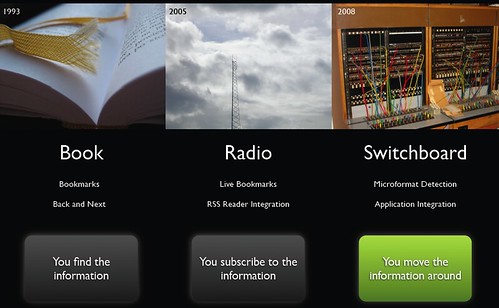
Esto no es más que otro capítulo de la vieja lucha establishemnt empresa-céntrica vs la libre iniciativa. Al final del día, mis amigos que saben dicen que Mozilla es muchísimo mejor. El futuro, según cuentan las propias autoridades de Mozilla, es Firefox 3: "moverse" en la información

=========================================================

Those were the days, my friends... when Netscape was released. January 1998. Ten years ago Internet was still rising, only a hundred or so of millions in the whole world, dotcom collapse didn´t occur yet, plenty of investment in Silicon Valley and here in LatAm watching how portals and ISP were adquired by major telcos.

But something is still going on. The "way we see the web" (WWSTW, and I´d like to be given the credits of this in other ten years) is still an issue. Is there any analogy in other fields? Explorer works "fine" in most applications but Mozilla excels. Explorer fails in more socialized versions of the web (try new Facebook apps in Explorer). But as perversity is the name of the game, most of designers thinks most in Explorer while doing their job.

Flashback, ten years ago. How was the feeling, then?

MOUNTAIN VIEW, Calif. (January 22, 1998) -- Netscape Communications Corporation (NASDAQ: NSCP) today announced bold plans to make the source code for the next generation of its highly popular Netscape Communicator client software available for free licensing on the Internet. The company plans to post the source code beginning with the first Netscape Communicator 5.0 developer release, expected by the end of the first quarter of 1998. This aggressive move will enable Netscape to harness the creative power of thousands of programmers on the Internet by incorporating their best enhancements into future versions of Netscape's software. This strategy is designed to accelerate development and free distribution by Netscape of future high-quality versions of Netscape Communicator to business customers and individuals, further seeding the market for Netscape's enterprise solutions and Netcenter business.
========================================================

What about the future? Perhaps this slide talks by himself. According to Mozilla developer Alex Faaborg the idea is to move around the information -far beyond bookmarking or even RSS feeds-. According to Alex, microformats are the answer to this issue - but which ones will Firefox natively support? Alex outlined 3 fundamental types: identity (hCard), geo (geo, adr), and calendar (hCalendar).

martes, 22 de enero de 2008

Facebook in a nutshell -or two-


If you are familiar to this blog you`ve realized by now that I don´t like Facebook very much.
I have two reasons for that:
  • There is always a continuous crossing of boundaries (personal vs professional).
  • You always have to check on new indiscrete applications -or just avoid them-. If not carefully understood their impact, this applications may invade your "friends" space.
Having said this, here´s a list of Facebook characteristics that may be of some help, or as I put it, "Facebook in a nutshell".
  1. The Wall is merely a space. It is placed on each user's page allowing friends to post messages for the user to see. One user's wall is visible to anyone with the ability to see their full profile. Many users use their friend's walls for leaving short, temporal notes.
  2. One of the most popular applications on Facebook is the Photos application, where users can upload albums of photos, tag friends, and comment on photos. About 60 million photos are added each week. That means 5 terabytes of disk space.
  3. A somewhat naive feature in Facebook are gifts. They are displayed in the website's gift shop. Frinds can send "gifts" –which are small icons of novelty items- to each other by selecting one from Facebook's virtual gift shop and adding a message. Gifts given to a user appear on the recipient's wall with the giver's message, unless the giver decided to give the gift privately, in which case the giver's name and message is not displayed to other users. Facebook users are given one free gift to give upon account signup.
  4. Facebook includes a "poke" feature which allows one user to send a “nudge" (in the Messenger sense) to another. According to FAQ "a poke is a way to interact with your friends on Facebook" (...) "People interpret the poke in many different ways, and we encourage you to come up with your own meanings." In principle this is intended to attract the attention of the other user. Some users take it as a sexual advance. This interpretation of the feature inspired a popular Facebook group titled "Enough with the Poking, Lets Just Have Sex", which, as of December 2007, has more than 340,000 members.
  5. The "status" feature allows users to inform their friends and the Facebook community of their current whereabouts and actions. This very much resembles Twitter functionalities.
  6. Facebook events are a way for members to let friends know about upcoming events in their community and to organize social gatherings. Events can be open, closed, or secret. When setting up an event the user can choose to allow friends to upload photos, video, and posted items.
  7. The Facebook Platform provides a framework for developers to create applications that interact with core Facebook features. Now there are more than 10,000 applications. Some metrics have changed along the months, as Facebook changed the way in which the popularity of applications is measured, in order to give more attention to the more engaging applications. There is some criticism about the attention some applications received only by growth; in fact they were highly viral, yet useless applications. This effect deserved the name of "cornucopia of uselessness." OK, my judgement is biased...
  8. Facebook released an application of its own for sharing videos. Users can add their videos with the service by uploading video, adding video through Facebook Mobile, and using a webcam recording feature.

Since I have some passion for contradiction, I have recently joined the Keira Knightley Atonement Green Dress Appreciation Society Facebook group. Useless? Well... it´s another Facebook application, you see.

martes, 15 de enero de 2008

MacBook Air vs Sony Vaio

The VAIO, as an ultraportable machine with long battery life, is impressive. The integrated DVD drive is a plus, too. A Sony Vaio IS TINY by definition (not designed for huge fingers).

The MacBook Air, on the other hand, will be an impressively portable, basically-full-size computer. It won’t feel small and tiny like the VAIO but it likely won’t weigh you down much (about 1.5 kg) either. Both laptops have similar perfomances based on Corel 2 Duo processors with some advantage for MacBook. Same happens with RAM: Apple’s comes with 2GB of 667MHz DDR2 SDRAM. Sony’s comes with 1GB of 533MHz DDR2 SDRAM.

Finally, Sony’s site has the VAIO listed at $2099. You can currently get it at Best Buy for $1849. The MacBook Air is $1799, launch price.

miércoles, 9 de enero de 2008

Jennifer Lopez charts

"A Jennifer Lopez chart is an informal technical analysis term used to indicate the rounding bottom in a stock's price, especially as seen on a chart or graph. The term is inspired by singer and actress celebrity Jennifer Lopez, who is known for having a curvaceous figure".

No fun at all. Quote belongs to Investor Words. I wonder about some Angeline Jolie index.

martes, 8 de enero de 2008

Facebook: Are you a Zoosker?

So the big-big benefit of Facebook is letting developers push their content into Facebook home with zero effort. Good try. And what about the users? Do they know what are they using?

In real life you don´t try new medicine unlees it is advised -your doctor, a friend, whatever-. In Web 2.0 you´re just at one click away of installing unknown apps in your Facebook profile. Throwing snowballs (is it as stupid as I reckon?), promote hotness (whatever it is), bother all your LinkedIn connections trying them to get Facebook-ed, or just buy installing Zoosker -proposing yourself for "socializing" in its purest form.

In a recent Yahoo! post a married woman asked simply "What would you do if you find your husband added the 'zoosk'application on Facebook? Most of the answers were "talk to him, he probably didn´t meant to do it". That´s the problem with easy integration of features, not to mention the long-discussed surrender of personal information. "Zoosk is a fun way to socialize and meet other singles in your area" says Facebook. Once you click it, it´s not only that you sex appetite seems to be reloaded; everyone is informed in black and white that you are -so to speak- craving for casual sex.

One final comments from a user. "I haven't got 15 single friends to invite to this stupid app, and I shouldn't have to bug the ones that have no need for it just so I can use it!". As I see it, I have only two issues about this apps
i) the instant spread of the app to all contact list -maybe you didn´t want to-
ii) the blur between personal and professional activities.

As we have seen many times, the second issue is a key factor in Web 2.0 developments.